Sunday, 14 February 2016
Happy Valentine's Day, Fort Myers
On Valentine’s Day in 1850, a U.S. Army fort was established on the south bank of theCaloosahatchee River in southwest Florida. The War Department had ordered Major General David E. Twiggs to establish the fort in response to escalating hostilities between settlers and Seminoles in the area. As a Valentine’s Day gift for his daughter, General Twiggs named the fort after her fiancé, Colonel Abraham C. Myers, chief quartermaster for the Department of Florida.
Valentine’s Day and war seem a curious combination, and yet, the oldest known valentine still in existence today was written by a prisoner of war. The year was 1416.
“SICK OF LOVE”
In 1415, the Duke of Orléans was captured by the English at the battle of Agincourtand held a prisoner in England for 25 years. In the first year of his imprisonment in the Tower of London, young Charles penned the following Valentine (translated from medieval French) presumably to his wife.
A Farewell to Love
I am already sick of love,
My very gentle Valentine,
Since for me you were born too late,
And I for you was born too soon.
God forgives him who has estranged
Me from you for the whole year.
I am already sick of love,
My very gentle Valentine.
“…FROM YOUR VALENTINUS”
According to popular legend, the first Valentine in history was also penned in prison.
During the third century A.D., Roman Emperor Claudius forbade Roman soldiers to marry, but, so the legend goes, a Roman named Valentinus, who was a Christian priest, went about secretly and illegally marrying soldiers to their sweethearts, anyway. One may say the priest died for love, because he was caught and condemned to death. The night before his execution, he wrote a loving note to the little daughter of his sympathetic jailer and signed it “from your Valentinus.”
The Christian Church canonized Valentinus, but it wasn’t until around 498 A.D. thatPope Gelasius declared Feb. 14 to be “Saint Valentine’s Day.” The creation of a saint’s day on that date was an unsuccessful attempt to squelch the pagan fertility festival that the Romans had long enjoyed annually on Feb. 15.
During this popular festival the pagan priests sacrificed a goat (for fertility) and a dog (for purification) and then, to encourage fertility, they ran around gently slapping women and crops with the bloody strips of the sacrificed goat’s hide.
The high point of the festival was a lottery, in which young unmarried women put their names in a big urn and then the town’s bachelors drew names and then, well, you know.
SAINTS AND LOVERS
Over the past 1500 years, we’ve sort of toed St. Valentine’s Day away from being the observance of a saint’s day and back in the direction of an occasion for, well, you know. First, we quietly dropped the “Saint” from the name of the holiday. By the 1700s, exchanging valentine gifts and notes was becoming popular and if we know anything about those perfumed ladies and gentlemen with powdered wigs and rouged cheeks, we can be fairly certain that they weren’t using the occasion for religious observances.
THE MOTHER OF THE AMERICAN VALENTINE
New England-born Esther Howland was 20 in 1848 when she began to design Valentine’s Day cards. She asked her father, who owned the largest book and stationary store in Worcester, Massachusetts, to order paper laces and flowers from England for her project, and she created a dozen sample cards for her brother, a salesman, to show to his clients. He came home with $5,000 worth of orders. Esther promptly organized the New England Valentine Company, which would eventually gross annually over $100,000 in sales. Now, elaborate, ready-made Valentines, previously available only from Europe and at considerable expense, were available to young men and women of modest means.
However, the practice of buying and sending Valentine cards was considered by some to be “cheap and indecent.” On Valentine’s Day, 1856, the New York Timespublished the following editorial:
"Our beaux and belles are satisfied with a few miserable lines, neatly written upon fine paper, or else they purchase a printed Valentine with verses ready-made, some of which are costly, and many of which are cheap and indecent. In any case, whether decent or indecent, they only please the silly and give the vicious an opportunity to develop their propensities, and place them, anonymously, before the comparatively virtuous. The custom with us has no useful feature, and the sooner it is abolished the better."
FOOLISH LOVERS
Valentine greetings were not abolished. In 1862, New Yorkers, alone, mailed 21,260 Valentines; in 1866, 86,000. Perhaps the bloodiest war in U.S. history, the Civil War, inspired a growing need for expressions of love and a longing for love.
However, then as now, it was not always the thing itself, but how much it cost. In the 1860s, a few Valentines were sold for as much as $500 each, the equivalent today of over $8,000.
The New York Times described these exorbitantly priced Valentines as follows:
"Valentines of this class are not simply combinations of paper gorgeously gilded, carefully embossed and elaborately laced. To be sure they show paper lovers seated in paper grottoes, under paper roses, ambushed by paper cupids, and indulging in the luxury of paper kisses; but they also show something more attractive than these paper delights to the overjoyed receiver. Receptacles cunningly prepared may hide watches or other jewelry, and, of course, there is no limit to the lengths to which wealthy and foolish lovers may go."
Apparently, there is no limit to the lengths to which a father might go for his little daughter on Valentine’s Day, either. Can you imagine a Major General naming a U.S. Army fort after his daughter’s fiancé? Such foolishness!
Antonin Scalia Dies at 79: Control of the Supreme Court Now at Stake in 2016
The unexpected death of conservative Supreme Court Justice Antonin Scalia has suddenly raised the stakes of the 2016 presidential election, giving the American people not only a referendum on who should control the White House but the judiciary as well.
Scalia's absence imperils the 5-4 conservative majority on the court. A Democratic president elected next November would guarantee liberal control of the high court, while a Republican victory would cement the conservative majority for another four or eight years.
The Republican-controlled Senate is unlikely to confirm any replacement nominated by President Obama in his final months in office, leaving the decision hanging over the presidential campaign and giving the next president an enormous prize the moment he or she is inaugurated.
The issue has already emerged as a political battle, with Senate Majority Leader Mitch McConnell and multiple GOP candidates arguing that a future president should pick Scalia's successor. Obama, along with leading Democrats, have countered that such a lengthy delay would hamper the judicial system.
"The American people should have a voice in the selection of their next Supreme Court Justice," McConnell said in a statement. "Therefore, this vacancy should not be filled until we have a new President."
Addressing the nation from California on Saturday night, Obama hailed Scalia as a "towering legal figure" and challenged the Senate to consider and confirm his replacement.
"I plan to fulfill my constitutional responsibilities to nominate a successor in due time," Obama said. "There will be plenty of time for me to do so and for the Senate to fulfill its responsibility to give that person a fair hearing and a timely vote."
The ranking Democrat on the Judiciary Committee, Sen. Pat Leahy of Vermont, warned in a statement that the Supreme Court is "too important to our democracy for it to be understaffed for partisan reasons.
"Failing to fill this vacancy would be a shameful abdication of one of the Senate's most essential Constitutional responsibilities," Minority Leader Harry Reid said in a statement, setting up an intense conflict should Obama move forward with a replacement.
In clarifying the already enormous implications of the election, the news could raise the importance of electability in both primaries, especially given that the influence of the courts is even more critical in times of political gridlock.
In the meantime, Scalia's death complicates a number of high-profile cases currently before the high court, including Obama's sweeping executive actions on climate change and immigration.
Both Hillary Clinton and Bernie Sanders have pledged only to nominate justices who would overturn the court's 2010 Citizens United decision, which dramatically expanded the flow of money into politics by paving the way for super PACs and direct corporate donations.
And Clinton drew a hard line against GOP calls to wait until a new president is elected to replace Scalia.
"The Republicans in the Senate and on the campaign trail who are calling for Justice Scalia's seat to remain vacant dishonor our Constitution. The Senate has a constitutional responsibility here that it cannot abdicate for partisan political reasons," she said in statement.
Sanders later echoed that sentiment, with a spokesperson saying that the candidate believes the Senate has a constitutional duty to vote on confirmation. "Let's get on with it," Sanders said.
For the Republican field, the news immediately thrusts the issue of judicial nominations to the forefront of the race.
At Saturday's Republican debate, five of the six candidates on stage said they opposed Obama appointing a justice to succeed Scalia.
Jeb Bush said Obama had "every right" to nominate a Supreme Court justice and urged that the president seek a consensus nominee — but he said he was sure that would not happen.
"I think it's up to Mitch McConnell and everybody to stop it. It's called delay, delay, delay," Donald Trump said.
John Kasich said Obama should not nominate a justice so the people could decide through the presidential election what type of justice should serve. Florida Sen. Marco Rubio and Dr. Ben Carson also said the next president should make the nomination, not O
Texas Sen. Ted Cruz said, "The Senate needs to stand strong and say 'We're not gonna give up the U.S. Supreme Court for a generation by allowing Barack Obama to make one more liberal appointee.'"
The GOP candidates rushed to praise Scalia after the news of his death broke.
Cruz, who clerked for the late Chief Justice William Rehnquist and argued cases before the court as his state's solicitor general, said in a statement that Scalia "fundamentally changed how courts interpret the Constitution and statutes, returning the focus to the original meaning of the text after decades of judicial activism."
Rubio also implied that the Senate should refrain from confirming Obama's choice.
"The next president must nominate a justice who will continue Justice Scalia's unwavering belief in the founding principles that we hold dear," Rubio said in a statement.
Carson went further in explicitly calling on the Senate to reject any Obama nominee out of hand.
"Given the dire condition our democracy currently finds itself under Obama's ideological agenda, I call on the Senate to stop any attempts to fill this crucial seat until we the people elect a strong constitutionalist this November," he said in a statement.
Trump has been attacked in the past by rivals for suggesting his sister, Judge Maryanne Trump Barry, would be a "phenomenal" justice despite ruling against abortion restrictions in the past. However, he also added that she wasn't interested in the job.
He criticized Scalia late last year for comments he made during a hearing on an affirmative action case in which he suggested that underqualified African-American students might benefit from a "slower track school."
Trump was unreserved in his praise for Scalia on Saturday, however. "The totally unexpected loss of Supreme Court Justice Antonin Scalia is a massive setback for the Conservative movement and our COUNTRY!" Trump tweeted.
Kasich called Scalia "an essential, principled force for conservative thought that is a model for others to follow" in a statement.
A vacancy on the court during the remainder of Obama's presidency could leave two full Supreme Court sessions deadlocked 4-4. In the case of a tie, the lower court's decision is upheld, but no Supreme Court precedent is created.
Fourteen high court nominees has been blocked at least in part because of the president's lame duck status, according to CQ. The longest vacancy in history occurred under President John Tyler, who had several nominees fail before his successor, James Polk, succeeded in filling the seat vacated by Henry Baldwin two years earlier.
Saturday, 13 February 2016
How To Be Single Is Almost Groundbreaking
How to Be Single isn’t a particularly subtle movie. There is, for instance, a montage of a character moving to NYC while Taylor Swift’s “Welcome To New York” plays. So the fact that Hailee Steinfeld’s “Love Myself” accompanies the closing credits should tell you something about the fate of the movie’s protagonist. The song goes: “Gonna love myself / No, I don't need anybody else.”
Spoiler alert: How to Be Single (which opens in theaters today) does not conclude with the main character getting coupled up. In that way, it's almost revolutionary. Almost.
At the center of this sugary confection is Dakota Johnson’s Alice. Alice has a college boyfriend, but she decides they need some time apart, so she moves to the big city to get some Real Life Adult Experience under her belt. She befriends Robin, a hedonist played by Rebel Wilson, who encourages her to go out and hook up. She forms a booty-call friendship with a lothario (Anders Holm) and dates a single dad (Damon Wayans Jr.). She moves into her own place and gets really bummed out when she can't unzip her dress. (A tragedy of the highest order, certainly.) She nearly has a fling with her ex. Ultimately, Alice doesn’t settle down with Prince Charming. Instead, she solidifies her bond with Robin. She learns that it’s important to treasure your female friendships and relish the time in your life when you are on your own.
"I wanted to kind of send a message out there that it’s okay, that you’re going to be okay," screenwriter Dana Fox tells Refinery29. "Your friends can be your family. You don’t necessarily need someone else to complete you the way that society convinces you you do."
Typically, romantic comedies that end with a woman alone have a bittersweet tinge. InBroadcast News, Holly Hunter (wisely) chooses her journalistic integrity over a relationship. Julia Roberts dances with her gay best friend at the end of My Best Friend’s Wedding after reaching devastating lows trying to break up Dermot Mulroney’s marriage. Laura Linney gets the most depressing Love Actually storyline when she ends up spending Christmas with her mentally ill brother. How to Be Single may not be on par with those movies quality-wise, but its idea of a triumphant single lady breaks new ground. Even Carrie Bradshaw couldn't end up single. Her coupling with Mr. Big at the end of the series "ultimately betrayed what [the series] was about," creator Darren Star recently wrote. (How to Be Single is based on a book bySex and the City writer Liz Tuccillo.)
Which is not to say How to Be Single doesn't resort to storytelling devices that stretch human credulity. For instance, Alice’s sister, Meg (Leslie Mann), gets pregnant via IVF. In a fit of hormonal horniness, she hooks up with a nice young man in the form of Jake Lacy, who plays all the nice young men in movies and TV shows these days. They continue dating, despite her attempts to ditch him. When he finally gets wind that she’s pregnant, he’s not actually pissed or put off. He wants to be a stay-at-home dad. After a brief spat, they eventually live happily ever after. Then, there’s Alison Brie’s online dating-obsessed Lucy. After a particularly brutal dumping, she freaks out in a bookstore when reading to children...and promptly meets her future Mr. Right (Jason Mantzoukas).
Fox herself acknowledges that How to Be Single walks the line between reality and wish-fulfillment fantasy. (You won't see any of the characters glued to Tinder, even though dating apps are a routine part of single life these days.) The screenwriter explains that the goal was to evoke comfort-food films and TV series, like Bridget Jones's Diary and Sex and the City, while also calling them on their bullshit. "[We try to] have it work as one of those movies that makes you feel really good inside, but at the same time, we're taking the piss out of those movies."
How to Be Single essentially has the same lesson as many of its rom-com predecessors: The right guy will come along when you least expect it. But it weaves something new into that retro formula when it allows Alice to forge her future happily unattached. That shouldn't be radical, but in Hollywood, it is.
Spoiler alert: How to Be Single (which opens in theaters today) does not conclude with the main character getting coupled up. In that way, it's almost revolutionary. Almost.
At the center of this sugary confection is Dakota Johnson’s Alice. Alice has a college boyfriend, but she decides they need some time apart, so she moves to the big city to get some Real Life Adult Experience under her belt. She befriends Robin, a hedonist played by Rebel Wilson, who encourages her to go out and hook up. She forms a booty-call friendship with a lothario (Anders Holm) and dates a single dad (Damon Wayans Jr.). She moves into her own place and gets really bummed out when she can't unzip her dress. (A tragedy of the highest order, certainly.) She nearly has a fling with her ex. Ultimately, Alice doesn’t settle down with Prince Charming. Instead, she solidifies her bond with Robin. She learns that it’s important to treasure your female friendships and relish the time in your life when you are on your own.
"I wanted to kind of send a message out there that it’s okay, that you’re going to be okay," screenwriter Dana Fox tells Refinery29. "Your friends can be your family. You don’t necessarily need someone else to complete you the way that society convinces you you do."
Typically, romantic comedies that end with a woman alone have a bittersweet tinge. InBroadcast News, Holly Hunter (wisely) chooses her journalistic integrity over a relationship. Julia Roberts dances with her gay best friend at the end of My Best Friend’s Wedding after reaching devastating lows trying to break up Dermot Mulroney’s marriage. Laura Linney gets the most depressing Love Actually storyline when she ends up spending Christmas with her mentally ill brother. How to Be Single may not be on par with those movies quality-wise, but its idea of a triumphant single lady breaks new ground. Even Carrie Bradshaw couldn't end up single. Her coupling with Mr. Big at the end of the series "ultimately betrayed what [the series] was about," creator Darren Star recently wrote. (How to Be Single is based on a book bySex and the City writer Liz Tuccillo.)
Which is not to say How to Be Single doesn't resort to storytelling devices that stretch human credulity. For instance, Alice’s sister, Meg (Leslie Mann), gets pregnant via IVF. In a fit of hormonal horniness, she hooks up with a nice young man in the form of Jake Lacy, who plays all the nice young men in movies and TV shows these days. They continue dating, despite her attempts to ditch him. When he finally gets wind that she’s pregnant, he’s not actually pissed or put off. He wants to be a stay-at-home dad. After a brief spat, they eventually live happily ever after. Then, there’s Alison Brie’s online dating-obsessed Lucy. After a particularly brutal dumping, she freaks out in a bookstore when reading to children...and promptly meets her future Mr. Right (Jason Mantzoukas).
Fox herself acknowledges that How to Be Single walks the line between reality and wish-fulfillment fantasy. (You won't see any of the characters glued to Tinder, even though dating apps are a routine part of single life these days.) The screenwriter explains that the goal was to evoke comfort-food films and TV series, like Bridget Jones's Diary and Sex and the City, while also calling them on their bullshit. "[We try to] have it work as one of those movies that makes you feel really good inside, but at the same time, we're taking the piss out of those movies."
How to Be Single essentially has the same lesson as many of its rom-com predecessors: The right guy will come along when you least expect it. But it weaves something new into that retro formula when it allows Alice to forge her future happily unattached. That shouldn't be radical, but in Hollywood, it is.
Thursday, 11 February 2016
Inside Chris Christie's failed campaign
(CNN)New Jersey Gov. Chris Christie poured everything he had into New Hampshire, clawing his way up the polls in a crowded field and Donald Trump-dominated year while tainted by scandal back home.And Marco Rubio threatened to take it all away.
In the last few weeks before Tuesday's primary, and under fire from Rubio and his super PACs, Christie became pre-occupied with the Florida senator. Christie's criticism of the candidate grew increasingly sharp behind closed doors, according to people familiar with the conversations. He would see a Rubio interview or read a story featuring Rubio and complain to staff or supporters that he simply did not see the appeal. He listened to Rubio provide canned quotes in each debate and, when attacked, refuse to look Christie in the eye during his response, Christie told people. It was a sign of weakness -- and a sign of a weak candidate -- in his view.
How the outsiders won -- and the insiders crumbled
By Saturday night in Goffstown, New Hampshire, after Rubio's surprising third-place finish in Iowa, everyone knew what was coming, Rubio included.
"Marco, the thing is this," Christie said at the ABC debate at St. Anselm's College. "When you're president of the United States, when you're a governor of a state, the memorized 30-second speech where you talk about how great America is at the end of it doesn't solve one problem for one person."
Asked the next day how Rubio could've missed what was coming, Christie resorted to "the great political philosopher Mike Tyson," the famous former world heavyweight-boxing champion. "Everyone has a plan until they get punched in the face," Christie told reporters.
Christie, after all, had been getting punched in the face for two years. He could now take credit for wounding a candidate he and his team viewed as unprepared for the job. But that would be the extent of his accomplishments in New Hampshire. Tuesday night, he received his own knockout blow, finishing sixth in New Hampshire. Wednesday, he threw in the towel.
"I ran for president to say that the government needs to once again work for the people, not the people work for the government. And while running for president I tried to reinforce what I have always believed -- that speaking your mind matters, that experience matters, that competence matters and that it will always matter in leading our nation," Christie wrote in a Facebook post. "That message was heard by and stood for by a lot of people, but just not enough and that's OK."
The story of Christie's rise and fall in the state where he pinned all of his hopes is based on interviews with more than a dozen of his advisers, donors, fundraisers, supporters and rival campaign aides. In the end, Christie could not get past both his own personal baggage and his status as another governor of a moderate or blue state selling his personal appeal during a general election campaign to a Republican base clearly looking for new blood.
Carly Fiorina ends presidential bid
New Hampshire-based strategyOnce considered a front-runner in the 2016 sweepstakes, a litany of policy decisions back home in New Jersey, combined with the federal investigation into a politically driven bridge closing crafted by his staff in the governor's office, had marred his hopes -- so much so that many top Republicans wondered whether a run was worth it at all.
And in a race dominated by GOP outsiders like Trump, a governor touting his experience, a la Jeb Bush, Rick Perry, John Kasich and George Pataki, wasn't a strong sell.
Christie announced his candidacy knowing full well that he had a lot of ground to make up. With a group of top-tier advisers, he went to work early crafting a strategy to vault himself back into the GOP top tier.
That plan revolved around New Hampshire, following the tradition of the state's successful candidates: come often, work hard, shower the state's politicians with attention (or, in Christie's case, never-ending text messages) and the rest will take care of itself.
He would spend more than 70 days in the state, holding 160 events and 60 town halls.
New Hampshire primaries: 5 takeaways
But as the months moved along and Donald Trump upended every campaign's initial plans, the topline strategy inside Christie's team evolved into a multi-part bank shot -- one that even they would admit needed breaks to succeed.
On paper, it was perfect: First, Christie would use his deep connections to popular Iowa Gov. Terry Branstad to harness a better-than-terrible showing in Iowa. Then, he would go back to New Hampshire, where his campaign and its supporting super PAC had invested a majority of their resources in on-the-the ground work and television advertising to turn flagging favorability ratings upside down. Finally, he'd have a big debate night, and close the deal with the historically (and frustratingly) late-deciding voters in the state.
A strong showing Tuesday would then open the doors to their extensive supporter and donor networks --- a deep-pocketed group wary of sending a first-term senator like Rubio to the White House.
As the chairman of the Republican Governors Association in 2014, Christie helped elect seven new GOP governors and divvied up extensive financial resources -- to the tune of $100 million -- to help 17 others gain re-election. Prove his viability and those investments in time and money would come home, his advisers predicted.
By mid-January, it all seemed to be working. Christie's approval ratings had jumped as many as 20 points in Granite State polls. His town halls became events in themselves -- each bigger than the next. His campaign and supporting super PAC saw the events register so well that they became the basis of many of their television ads -- a straight-talking governor with real experience, who had notched a sweeping re-election victory in a traditionally Democrat-leaning state.
David Sacks, an independent voter from Hollis, vividly remembered his first interaction with Christie at a friend's house.
"He grabbed me immediately," Sacks said. He left the event saying to himself, "Man, this is the guy," he recalled. "Why not Christie?"
Attacked from all sides
But the liabilities never dissipated. New Jersey's economy, while on the upswing in recent months, had been bleak for much of Christie's tenure. Opposition research, shared with CNN from multiple campaigns, was extensive on areas where Christie allegedly took positions that broke with Republican orthodoxy.
One aide in a rival campaign put it succinctly: "We all saw his rise -- it was very real -- but we were never worried. We knew a week of negative ads would bring him back down to earth whenever we wanted."
That's exactly what happened.
Super PACs supporting Bush, Rubio and Kasich unloaded on Christie, attacking him on his state's acceptance of Common Core on education, the Bridge-gate scandal and past statements on gun control and abortion.
Rubio himself started reading, theatrically from a piece of paper pulled from his pocket, Christie's press release that appeared to make it look like he supported President Barack Obama's Supreme Court nomination of Sonia Sotomayor.
Within weeks, Christie's favorability ratings nose-dived and so did his poll numbers. Meanwhile, Christie's financial picture continued to worsen. He closed 2015 with a little more than $1 million to spend. While money was still coming in -- a series of fundraisers in January brought in seven figures, according to two people familiar with the process -- it wasn't nearly enough to challenge the seemingly endless attacks that were coming his way.
His foray into Iowa fell flat, even with the extensive Branstad connections and two campaign stops with the governor himself. He logged the 2% he'd been polling at for months and in the process, frustrated donors by undertaking a six-day swing through Iowa --- time that could have been spent working relatively unopposed in New Hampshire.
Going after Rubio
Days before New Hampshire voters went to the polls, Christie was struggling to stay in the conversation, falling into the mid-single digits and struggling to rediscover the message that connected. From that, the plan became: attack Rubio.
The initial attack was always in the plans, but just how personal it got was not, according to aides. During the drive to his New Hampshire campaign headquarters in Bedford, he made clear that while he was resolved to launch his first salvo, he would stay away from personal attacks.
At an arranged meeting with reporters after he greeted volunteers, he almost succeeded. He started by saying it would be an "interesting week" for Rubio and went through his practiced lines about the dangers of first term senators. But as the question and answer session was about to end, something clicked in Christie. He proceeded to launch into a three-minute personal indictment of Rubio's lack of political talent, reliance on advisers, inability to do retail politics and general lack of life accomplishment. He punctuated each attack line with a new nickname for Rubio: "the boy in the bubble."
The backstory is both strategic and personal for Christie. Rubio came out of Iowa with the wind at his back -- so much so that members of Christie's team received calls from certain party stalwarts that appeared to hint that it was time for Christie to drop out and the party to coalesce around Rubio. Christie, who had been swiping at Rubio for weeks in town halls, wanted to cut off the Florida senator's rise before supporters and, more importantly, donors started to flee.
Christie had a good idea that he'd pulled off what he pledged to do at Saturday night's debate, but he wasn't sure. It was none other than Donald Trump who confirmed what Christie thought during the first commercial break. "Wow. That was tremendous," Trump said, grabbing Christie's arm, according to a source familiar with the exchange. His next stop was a check-in with his wife, Mary Pat, standing off the stage. She echoed Trump's analysis.
The 72 hours that followed comprised of part victory lap --- it was clear Christie had frozen the post-Iowa rush of donors and supporters to Rubio -- and part urgent campaign push to lock in the voters falling away from the senator.
The campaign's internal polling showed a consistent uptick in Christie's numbers, but more and more, things were shifting toward Bush and among, undeclared voters, Kasich. While Christie did the work everyone in the race was hoping for, it increasingly looked like he wouldn't be the candidate to benefit.
Marco's reboChristie was convinced after Saturday that the race had been flipped on its head -- no longer was finishing first among governors the metric. Instead, it was survive and advance, get to the next debate and try for another big moment. Then CBS News released its criteria to qualify for the next debate. Only the top five in New Hampshire would move forward. By 10 p.m. on primary night, it became clear Christie would do no better than sixth.
As Christie walked to the podium in the ballroom at a Radisson hotel in Nashua, he remained convinced that he had connected with the people in the state -- and appeared to be genuinely surprised he didn't do better. It had become clear to him and his team that people had gravitated to his message.
"I have both won elections that I was supposed to lose and I have lost elections that I was supposed to win," Christie said. "And what that means is you never know, and it's both the magic and mystery of politics that you never quite know when which is going to happen even when you think you do."
For weeks as primary day approached, Christie would close his town halls with a story from one of his first events in the state. As Christie told it, he was approached by an elderly man after he wrapped up. The man was effusive in his praise for Christie. He liked what he had to say, he liked his positions and overall he was ready to vote for him. But he wouldn't, the man told Christie. Then he turned to walk away.
"Wait -- sir, tell me what I did?" Christie would recount to the chuckling audience. The man turned around slowly and informed Christie he hadn't done one crucial thing: ask for the man's vote. Christie quickly did just that.
The voter's response: "Too late."
Wednesday, 10 February 2016
Candidates looking beyond New Hampshire, Super Tuesday
The votes from New Hampshire are still being dissected and Michigan voters won’t cast ballots for another month, but the presidential campaigns are looking beyond South Carolina, Nevada and the 11 Super Tuesday states toward Michigan’s March 8 election.
Democratic presidential contenders Bernie Sanders and Hillary Clinton opened up their first campaign offices in the state this week.
Sanders, who is one of the only presidential candidates on either the Republican or Democratic side who hasn’t visited Michigan yet, has an office open in Flint and expects to christen four more later this week.
Clinton’s campaign, with help from Detroit Mayor Mike Duggan, launched its first campaign office in Detroit on Tuesday and expects to open up offices in Flint and Grand Rapids in the coming weeks.
And following up on her visit to Flint on Sunday, Clinton’s daughter, Chelsea, is scheduled to make campaign stops in southeast Michigan on Thursday and husband and former President Bill Clinton will be in Grand Rapids for a fund-raiser on Friday.
Republican Sen. Ted Cruz opened up four offices in Michigan — in Brighton, Roseville, Sault Ste. Marie and Grand Rapids — last week.
Ohio Gov. John Kasich, who has spent more time in Michigan than any of the other candidates with eight trips to the state, plans to spend two days in Michigan next week with events at Grand Valley State University in Grandville and Utica on Monday and in Livonia on Tuesday.
Michigan is especially important, said Farmington Hills political consultant Paul Welday, because it could provide the momentum the candidates need to hit the states after Michigan where Republican delegates are awarded on a winner-take-all basis, rather than proportionately as is the case for all the states that hold presidential caucuses or primaries before March 15.
“Each one of these campaigns know that the headlines after Michigan’s election are going to influence the big winner-take-all states that follow us,” he said. “We’re really uniquely positioned to open up this race. And Michigan is the first major industrial state on the docket to vote.”
And for Democrats, the tight race between Clinton, the former secretary of state, and Sanders, the Vermont senator, makes every state important.
“It will show that if you can win in Michigan, you can be a very strong general election candidate,” said Brandon Dillon, chairman of the Michigan Democratic Party.
Three other states — Hawaii, Idaho and Mississippi — also have presidential primary elections on March 8, but Hawaii is difficult logistically for candidates to spend much time in and only has 19 Republican and 33 Democratic delegates up for grabs.
Idaho has only 32 Republican delegates and 27 Democratic delegates at stake compared to Michigan’s 59 for Republicans and 148 for Democrats.
Mississippi has 40 Republican and 41 Democratic delegates up for grabs. Hawaii and Idaho only have Republicans up for election on March 8 while Mississippi and Michigan have both Republicans and Democrats on the ballot.
Tuesday, 9 February 2016
Chipotle Meeting Outlines Food Safety to Workers and Message for Public
Chipotle Mexican Grill closed its more than 2,000 restaurants for four hours on Monday to hold a “virtual” town hall meeting with its employees about steps it said it was taking to improve food safety and regain consumers’ trust.
“People will come back,” Steve Ells, the company’s founder and co-chief executive, told more than 50,000 employees, who were connected to Chipotle’s Denver headquarters via video.
Emphasizing his faith in that statement, he said the company had no intention of slowing its growth this year.
The company allowed a wire-service reporter and a reporter from Fast Company into the hourlong meeting, and it tweeted some statements made by its executives and photos of them and employees.
It also posted a video clip on Periscope of Mr. Ells announcing a $10 million program to help small farmers who are Chipotle suppliers shoulder the costs of putting in place the company’s new food safety system, which will require them to do more rigorous testing.
“That means even the ingredients they sell to other companies will be safe — and that’s good for everybody, not just Chipotle,” Mr. Ells said.
Marketing experts applauded the company for its transparency about the meeting, but said the company would need to do a lot more to win back the trust of consumers. Chipotle has experienced six food safety failures involving norovirus, salmonella and E. coli since July, with more than 500 customers reporting that they fell ill afterward. Most of those illnesses were associated with two outbreaks of norovirus.
“Whether that’s sufficient to persuade consumers to come back in a significant way is questionable,” said Allen Adamson, founder of BrandSimple, a marketing consultancy. “It’s going to take significant meaningful action that goes beyond telling employees to be more careful and, unfortunately, some time before consumers start to believe it.”
Mr. Adamson said the best example of a company regaining consumer trust was of Tylenol in 1982 after seven people died after taking medicine that had been tampered with. Johnson & Johnson, the maker of the painkiller, moved quickly to recall the product and establish ties with the police, the Food and Drug Administration and other authorities so that the company would have accurate information on the investigations.
Tylenol’s market share crashed, but Johnson & Johnson introduced new tamper-proof packaging and heavily promoted the brand. Today, Tylenol is a best-selling over-the-counter analgesic. “Johnson & Johnson bent over backwards and made meaningful changes to the way the product was sold,” Mr. Adamson said. “To rebuild trust, actions speak louder than words.”
Consumers are clearly still concerned about eating at Chipotle. Stores in places like Seattle, New York City and Boston have been far less busy since the outbreaks became big news, driving Chipotle’s sales in stores open at least a year down by 14.6 percent in the last quarter of last year.
Patrick Quade, the founder of Iwaspoisoned.com, a website that allows people to report when they get sick after eating something, said he had detected a potential problem in Chipotle’s Simi Valley, Calif., store long before news of the norovirus issue was reported because an unusually high number of people had been reporting illnesses after eating there. Now, some 35 state, county and city health departments have signed up for services from the site, which are free.
When asked about the illnesses on Iwaspoisoned.com, a Chipotle spokesman, Chris Arnold, said that the Centers for Disease Control and Prevention “estimates that roughly one in six Americans get some form of food-borne illness every year.” “Absent a medical diagnosis and epidemiological analysis,” he added, “it’s very difficult to actually determine what caused someone to become ill.”
Chipotle has a loyal customer base, and many company tweets during the town hall meeting were in response to consumers who had asked when the stores would reopen on Monday.
But consumers were also tweeting about food illnesses. For instance, someone tweeting from Washington, D.C., as @Obi Bron Ginobi wrote: “you guys gave me food poisoning back in November. Can’t believe it’s taking this long to try and rectify the problem.”
Chipotle responded to the messages with apologies and requests for more information.
Chipotle gave more insight into what it believes caused some of its woes. The norovirus contaminations that caused the greatest number of illnesses occurred in two stores, one in Simi Valley, Calif., and one in Boston, and were introduced to the restaurants by sick employees, said Monty Moran, the company’s co-chief executive.
Since the outbreaks, the company has instituted paid sick leave for employees in an effort to encourage them to stay home and has told employees they should report their colleagues who come to work when they are sick.
Mr. Moran said that a salmonella outbreak in Minnesota and Wisconsin that sickened more than 60 people was linked to chopped tomatoes. The company now washes, dices and tests tomatoes in its central kitchens and then ships them in sealed bags to restaurants, Mr. Moran said.
As for the most serious contamination, two different types of E. coli that sickened 60 people after they ate in Chipotle restaurants in 14 states, Mr. Moran said neither Chipotle nor the C.D.C. had been able to determine the exact cause. The C.D.C. closed its investigation last week.
Chipotle has started its most expensive marketing and promotion campaign ever and plans to spend some $50 million to try to lure existing customers back into its restaurants and communicate the steps it has taken to improve its food safety practices. Signs in store windows on Monday, for instance, invited customers to text the company for a free burrito.
Monday, 8 February 2016
New Hampshire Voters Hear Candidates’ Final Appeals Before Primary
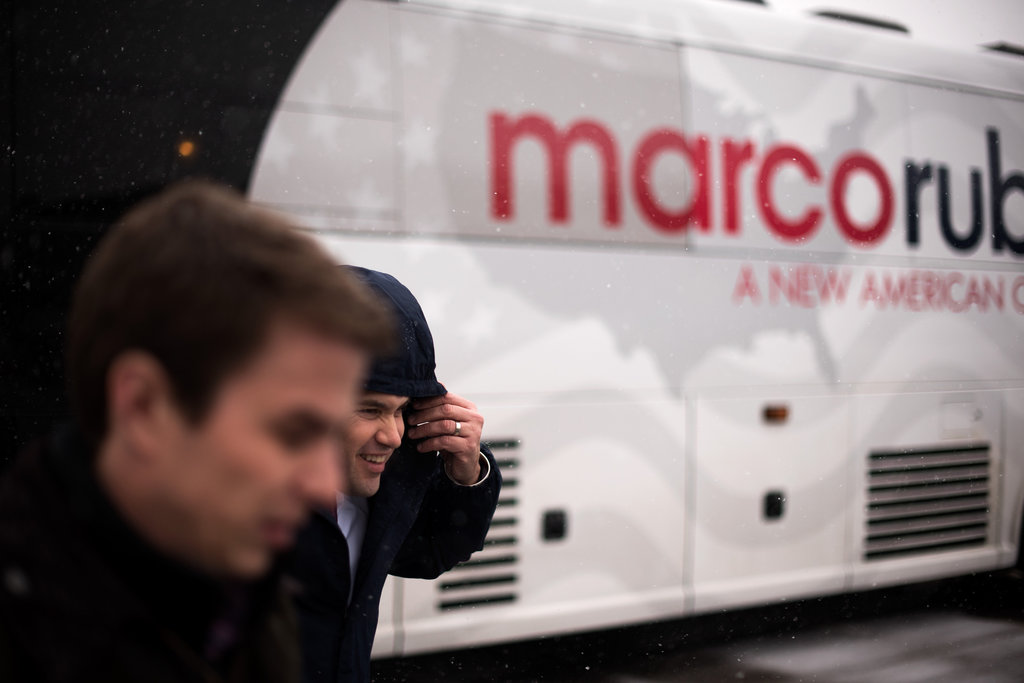
MANCHESTER, N.H. — A rambunctious herd of presidential candidates dashed across a snowy New Hampshire on Monday, making last-ditch efforts to persuade undecided voters on the eve of the nation’s first primary election, the outcome of which could bring a dose of clarity to a campaign that has become surprisingly muddled.
In a final exchange of cutting accusations over money and preparedness for the White House, the Republican and Democratic contenders urgently jockeyed for advantage in what remain two surprisingly fluid contests.
The infighting among the candidates at times crossed over into meanspiritedness: Jeb Bush called Donald J. Trump a “loser.” Mr. Trump called Mr. Bush an “embarrassment.” Gov. Chris Christie said Senator Marco Rubio had “melted” under pressure.
And Hillary Clinton lodged a dubious accusation at Senator Bernie Sanders, suggesting that he had taken large donations from Wall Street, in an attempt to raise doubts about Mr. Sanders’s own independence from big banks. Mr. Sanders’s campaign said she was lying.
But with New Hampshire’s history of defying polls and the sense of confusion that Mr. Trump’s candidacy has imposed on the presidential race, a glut of contenders clung to the idea that anything could be possible on Tuesday.
As a snowstorm complicated the final crush of campaign events on Monday, Republicans scrambled to outperform recent polls that suggested Mr. Trump was the favorite to win the state, with a glut of more mainstream candidates locked in a battle for second place.
An unusually subdued Mr. Trump, who faced criticism for canceling an event on Friday because of snow, expressed some concern about the weather.
“Why does it have to snow now?” he said at a town-hall-style meeting in Salem. But he urged voters to show up at the polls on Tuesday regardless, saying, “This is like a destiny thing.”
“I don’t care if it snows or not, we got to vote,” Mr. Trump said. “I’m not asking for your money. I’m asking for your vote.”
The storm, which began before noon and was expected to drop several inches through Tuesday morning, had all the campaigns talking to their field organizers to ensure they were prepared for get-out-the-vote complications.
Members of Mr. Bush’s campaign staff said they were prepared to offer voters rides to the polls, and Mrs. Clinton said in an interview with WBZ radio, a Boston station, that aides and volunteers were ready to help voters reach the polls no matter how bad the conditions were.
At an afternoon rally at Manchester Community College, Mrs. Clinton sought to lower her threshold for what would constitute a success in the state’s Democratic primary even as she threaded her stump speech with a more personal reminder to New Hampshire voters that they had stood with her family before.
“As for all of those who are still deciding, still shopping, I hope I can close the deal between now and the time polls close,” she said.
Former President Bill Clinton, who introduced his wife, struck a softer tone regarding Senator Bernie Sanders of Vermont, her rival for the Democratic nomination, than he did the day before. On Sunday, he drew unwanted attention for lashing out at Mr. Sanders, who holds a big lead in New Hampshire polls.“I have to be careful what I say,” Mr. Clinton said, to laughter.
Mr. Sanders, who took the stage in a packed theater in Manchester on Monday, was less cautious in expressing optimism about Tuesday.
“I think we are going to do just fine tomorrow,” he said before launching into his unvarying stump speech focused on income inequality and an array of liberal proposals.
Sniping between Mrs. Clinton and Mr. Sanders, and between their campaigns, continued to ricochet. Struggling to shake Mr. Sanders’s suggestion that she is beholden to Wall Street, Mrs. Clinton on Monday accused him of hypocrisy, asserting that he had accepted $200,000 in donations from the banking industry by way of the Democratic Senate Campaign Committee.
But Jeff Weaver, the chairman of Mr. Sanders’s campaign, accused Mrs. Clinton of lying out of desperation, saying the ultimate sources of the donations from the Senate Democrats’ campaign arm also included labor and environmental groups. In a statement, he called Mrs. Clinton’s gambit “laughable” and said it showed her campaign was in “disarray.”
In the crowded Republican field, the candidates lashed out at one another at campaign stops, in television interviews and on social media.
“You aren’t just a loser, you are a liar and a whiner,” Mr. Bush wrote in apost on Twitter, directed at Mr. Trump.
Mr. Trump did not pull punches in response, telling CNN that Mr. Bush seemed to be having a “breakdown.”
“He’s an embarrassment to his family,” Mr. Trump said. “He has to bring his mother out and walk his mother around at 90 years old. I think it’s a very sad situation that’s taking place.”
Mr. Rubio, the Florida senator, continued to face ridicule over his embarrassing debate performance on Saturday night, in which he repeated the same critique of President Obama several times. Several said Mr. Rubio had cracked under pressure and was not ready to be president.
“When the lights get that bright, you either shine or you melt,” Mr. Christie said at a town-hall-style event in Hudson. “We cannot afford to have a president who melts.”
Campaigning in Nashua, Mr. Rubio at times appeared listless, but continued to defend his debate performance, even bringing it up himself. When a member of the audience at a town-hall-style meeting asked him about America’s relationship with Israel, Mr. Rubio pivoted to the same refrain about Mr. Obama.
“You know, one of the things that’s funny because people keep, uh, you know — the press, anyway — ‘Why do you keep saying the same thing about Obama trying to change America?’ ” Mr. Rubio said defiantly. “I am going to keep saying that a million times because I believe it’s true.”
Later in the day, during a stop at the Barley House restaurant in Concord, Mr. Rubio flashed his growing frustration with the sustained criticism coming from the New Jersey governor.
“If you’re Chris Christie, and you supported gun control, gave a personal contribution to Planned Parenthood, supported Sonia Sotomayor’s appointment to the Supreme Court and are a big strong proponent of Common Core, you can’t run on your record,” Mr. Rubio said, rattling off the biggest conservative knocks on Mr. Christie
Yet the question of Mr. Rubio’s experience dogged him again on Monday. During the town hall meeting, held at an aerospace contractor’s Nashua offices, another member of the audience pointedly asked him to name his single biggest accomplishment in the Senate — the focus of his rivals’ attacks during the debate.
Mr. Rubio ticked through the same list he had mentioned on Saturday night, citing his role in passing new sanctions against Hezbollah and his work fighting the trafficking of young girls.
But his opponents did not let up. Mr. Bush, the former Florida governor, made a point of portraying Mr. Rubio, his former protégé, as too inexperienced to be commander in chief.
“He doesn’t have a proven record, and I think people aren’t willing to make a risky bet on that,” Mr. Bush said on MSNBC.
Mr. Bush pointed to his own crowds, which have been growing in recent days, as a sign that New Hampshire Republicans were wising up in the countdown to Tuesday’s vote.
“What they’re doing, I think, is saying, ‘We want someone with a steady hand as president of the United States, not someone that just talks trash or someone who’s scripted,’” Mr. Bush said.
Gov. John Kasich of Ohio, who is also vying for second in New Hampshire, was also unsparing when it came to Mr. Rubio. “People are looking not only to understand what’s in your head, but they also want to know what’s in your heart,” he said outside a library in Plaistow as snowflakes swirled around him. “And if all you are is scripted, I’m not sure people respond to that.”
Despite slippery streets, voters filled forums in libraries, lodges and even a metal fabrication plant to get last looks at the candidates. Many remained undecided.
Some were less than welcoming, such as a heckler in Raymond who told Senator Ted Cruz of Texas that Mr. Cruz was “possessed by a demon.”
Mr. Cruz had a friendlier welcome from a crowd of Tea Party adherents in Manchester later in the day. “Have you noticed everyone says they are conservative?” he said of his Republican rivals. “They don’t say, ‘I’m an establishment moderate squish.’ ”
He also leveled a none-too-veiled critique at Mr. Trump: “If you think Washington is fundamentally broken, the solution isn’t to elect a deal-maker,” Mr. Cruz said. “How else do you think you get a $19 trillion debt?”
Linda Bournival, 55, a self-employed actuary from Kingston, thought she was going to vote for Mr. Rubio. But she said the debate had spurred her to take in another talk from Mr. Christie, whom she had seen before.
Ms. Bournival said she was a fan of Mr. Christie for his battles against teachers’ unions in New Jersey, but also appreciated Mr. Rubio’s “way of approaching politics.” She said she did not want to be completely swayed by the debate. Still, she said, after the debate, “I started thinking more about what are his accomplishments.”
After defying the polls in the Iowa caucuses, Mr. Rubio did a little expectations-lowering on Monday. When a woman at a Nashua diner asked him, “You’re going to win, right?” he quickly responded, “Sure!”
But he added, smiling: “It’s just going to take a little longer, that’s all.”
Subscribe to:
Posts (Atom)